One thing, done magnificently
We do one subject in one style: your cat as a Victorian oil portrait. No style picker, no filters, no gimmicks — only restraint, craft and a paw placed firmly on the good chair.
About the studio
Lord Whiskers was founded on an observation any cat owner will recognise: your cat already carries itself like aristocracy. The disdainful glance, the impeccable posture, the certainty that the good chair belongs to them. All that was missing was the portrait.
So we built a studio in the spirit of the great Victorian portrait houses. Send us a photograph of your cat and our artists' easel — equal parts oil paint and modern ingenuity — renders them in velvet, lace and medals, lit like a Rembrandt and framed like a masterwork. The result can be taken as a digital file or rendered on a choice of printed formats, all delivered to your door.
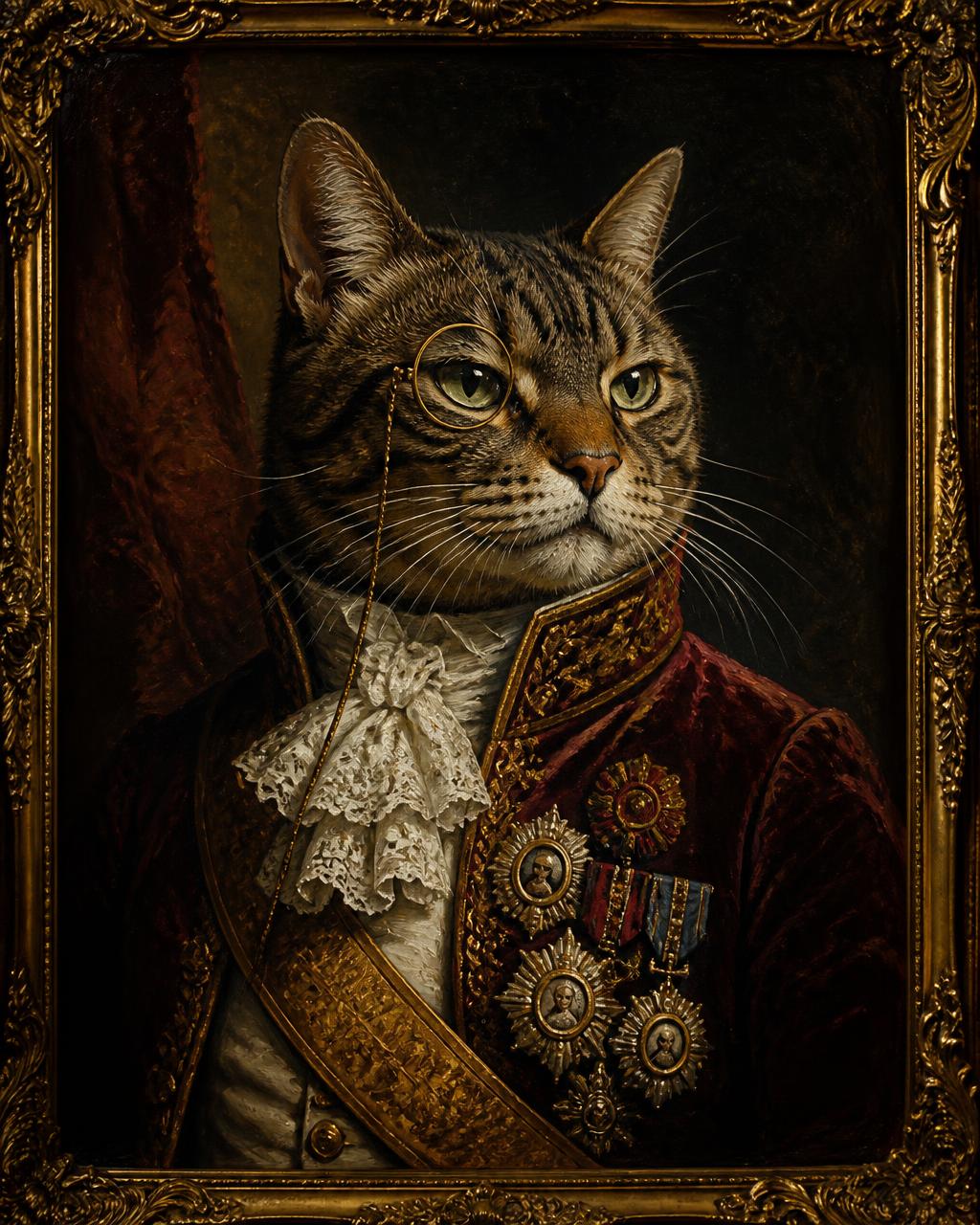
We do one subject in one style: your cat as a Victorian oil portrait. No style picker, no filters, no gimmicks — only restraint, craft and a paw placed firmly on the good chair.
Every portrait is painted from your own photograph, preserving your cat's real fur colouring, markings and expression. His Lordship would accept nothing less.
The preview is free and watermarked. You pay only when the likeness meets your approval — a commission in the true old sense of the word.
Our gallery-wrapped canvases arrive ready to hang; framed canvases come in a choice of colours; and the fine art print is supplied unframed for you to frame as you wish. The mug, of course, is ready for the table.
The hands behind the house
This studio is not a faceless storefront. It is owned and run by two people who have spent their working lives in businesses where a customer's bad day lands on you personally — and who have, between them, spent a very long time learning that the promise is the product.
The other spent a career in enterprise technology.
At PepsiCo, at CRH Americas and at Hensel Phelps, the work was the kind that only becomes visible when it fails. Systems relied upon by thousands of people do not get to have an off day. Nobody sends a note of thanks because the network stayed up; they notice the four minutes in a year when it did not. You stop designing for the good day and start designing for the bad one.
The specialisms were infrastructure and operations: centralising Citrix environments across North America, active and passive datacentres, field services, database administration. Underneath the acronyms — CCNA, MCSE, CCA — the discipline is unglamorous and transferable. Assume it will break. Know what you will do when it does. Make sure the person affected hears it from you first, and hears something true. Twice honoured with the PepsiCo Chairman's Award, which in a company of that size is not given for enthusiasm.
Large organisations also teach you exactly how a customer gets lost — not through malice, but through handoffs. A request passes between three teams and arrives nowhere. A ticket is closed because it satisfied a metric rather than a person. That is why this studio is deliberately small and deliberately direct: no support tier, no queue, no department to be routed to. A photograph of your cat, a portrait made properly, and two owners who can both be reached.
The habit that carries over is verification. In infrastructure you do not declare something fixed because you changed a setting; you declare it fixed when you have watched it work. A portrait is not finished because the software produced a file. It is finished when it looks like your cat, and the person who ordered it says so.
One of us has spent over thirty-five years in retail.
Thirty-five years on the other side of a counter teaches one lesson above all others: the customer is priority one, and has been from the first day. Not as a slogan painted on a wall, but as the thing that decides whether there is a business next year. You learn to read when someone is unhappy before they say so. You learn that the person in front of you is not an interruption to the work — they are the work.
That same instinct built a family farm from the ground up. Turf is a living product with a short memory: grown for months, cut in hours, failing from the moment it leaves the field. A late delivery is not a support ticket. It is a landscaping crew standing idle, a contractor whose week collapses behind him, a homeowner who took the Saturday off and now has bare earth and family arriving at six. People are not buying grass. They are buying the certainty that it will be there when they were told.
Serving homeowners, landscapers and contractors across Dallas–Fort Worth means three customers measuring you by three different yardsticks — and a good deal of that work done in two languages, because explaining yourself plainly to the person doing the work prevents more problems than any paperwork afterwards.
Two decades of Saturdays in social services at a local church, and a seat on the Boys and Girls Clubs Alumni Council, come from the same place: showing up matters more than talking about it.
A portrait of somebody's cat is closer to a Saturday delivery than it looks. It is bought with feeling, it is often a gift, and the person waiting has already imagined the moment it arrives.
Not a slogan on a banner. It means you see your cat's portrait before you spend a penny. It means that if something is wrong, we make it right, and you choose how. It means a real person reads your message and answers it.
We know precisely what we are asking. You are trusting a small studio with a photograph of a companion you love, and with your money, on the strength of a website. We do not take that lightly.
We thank you, sincerely, in advance for your business.